
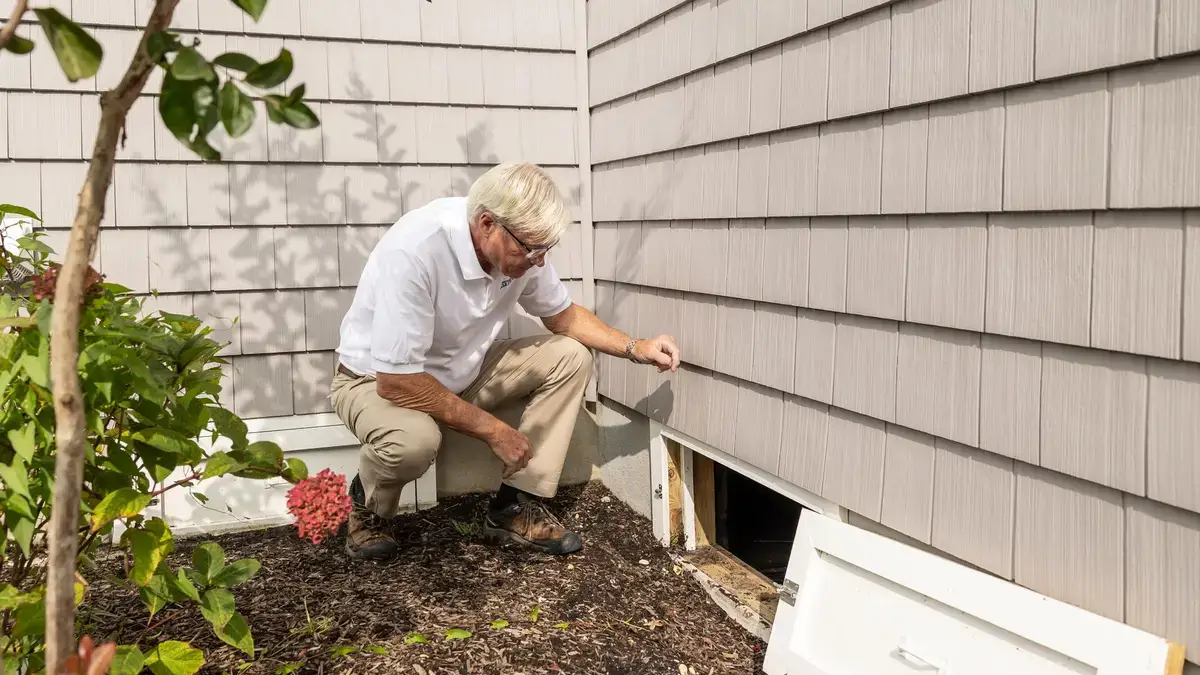
Almost every home we work on around Cleveland and Charleston has one, and almost nobody goes in it. The crawl space is the part of the house that gets thought about only when something has already gone wrong upstairs.
It deserves more attention than that, because it has its own climate, and in East Tennessee that climate is working against the house for a good part of the year.
The vents were supposed to fix this
Older crawl spaces were built with foundation vents on the theory that outside air moving through the space would carry moisture out of it. In a dry climate that logic holds.
In the Tennessee Valley it frequently reverses.
Here is the mechanism. Warm summer air holds a great deal of water. When that air enters a crawl space, it meets surfaces that are considerably cooler, because the ground below stays cool year round. As the air cools, it cannot hold the same amount of water, so its relative humidity climbs. Cool it far enough and the water comes out of the air entirely, onto ductwork, onto pipes, onto the underside of the subfloor.
The vent did its job. It moved air. The air was the problem.
This is why crawl spaces are usually at their worst in July, not January. It is the opposite of what most people expect.
The real source of the water
When a crawl space is damp, the first assumption is a plumbing leak. Sometimes it is. More often the water is arriving through the ground.
Bare soil in a crawl space is not a barrier. Moisture moves up through it continuously by evaporation, and a crawl space with an exposed dirt floor is effectively being humidified from below, every day, whether or not it has ever rained.
Add the usual contributors and it accumulates:
- Grading that slopes toward the house rather than away from it
- Gutters and downspouts discharging next to the foundation instead of away from it
- Missing or torn vapor barrier, which is the plastic sheeting that is supposed to separate the soil from the air
- Dryer vents terminating under the house rather than outside it
- Condensation on uninsulated ductwork, which can drip steadily all summer
None of these are leaks. All of them are sources.
Why pests care
Insects are not looking for your house. They are looking for water, food, shelter and a route. A damp crawl space offers three of the four before anything else happens.
Moisture. Many pests are limited by dehydration more than by anything else. A reliably damp space removes that limit.
Softened wood. Wood that stays wet becomes easier for insects to work in, and it can begin to support fungal growth, which is itself a food source for some species.
Cover. Dark, undisturbed, temperature-stable, rarely entered by anyone. Very little in a house matches that description.
Termites in particular are worth naming here. Subterranean termites need contact with soil moisture, and a damp crawl space with wood nearby is a favorable arrangement for them. That is why a termite inspection includes the crawl space, and why what is found down there shapes the recommendation. Termite Shield starts at $200 and begins with that inspection.
The signs that show up upstairs
You do not have to go under the house to notice a crawl space problem. It reports itself through the floor:
- A musty smell in rooms on the ground level, strongest near floor vents or in closets on outside walls
- Floors that feel cool or damp in summer, or that have developed a slight give
- Cupping hardwood, where board edges rise higher than their centers
- Humidity that will not come down even with the air conditioning running
- Insects appearing along ground-floor baseboards with no obvious outside entry
That upward path is real. Air moves from a crawl space into the living area continuously as warm air rises and leaves the house through the roof, pulling replacement air up from below. What is in the crawl space air does not stay in the crawl space.
What can be done about it
The general direction is to stop treating the crawl space as outdoors and start treating it as part of the building:
- Move water away from the foundation. Extend downspouts, correct grading. This is unglamorous and it is usually the highest-value step.
- Cover the soil. A properly installed and sealed vapor barrier stops ground moisture from evaporating into the space.
- Deal with the air itself. Depending on the space, that can mean sealing it from outside air rather than venting it, and managing humidity mechanically.
- Fix the obvious sources. Redirect the dryer vent, insulate sweating ducts, repair actual leaks.
Which of these applies, and in what order, depends entirely on the space. Crawl spaces vary enormously even between neighboring houses: height, soil, grading, drainage, how much of the original barrier is left. That is why Crawl Space Shield is quoted after the team has actually seen the space rather than from a description.
Worth checking before winter
The practical suggestion is simple. If nobody has looked under your house in a few years, that is reason enough to look, and the change of season is a reasonable prompt.
If the space is damp, that condition is not going to resolve on its own, and everything that finds it favorable will keep finding it favorable. Tell us what you are noticing and we will take a look at what is actually going on down there.