
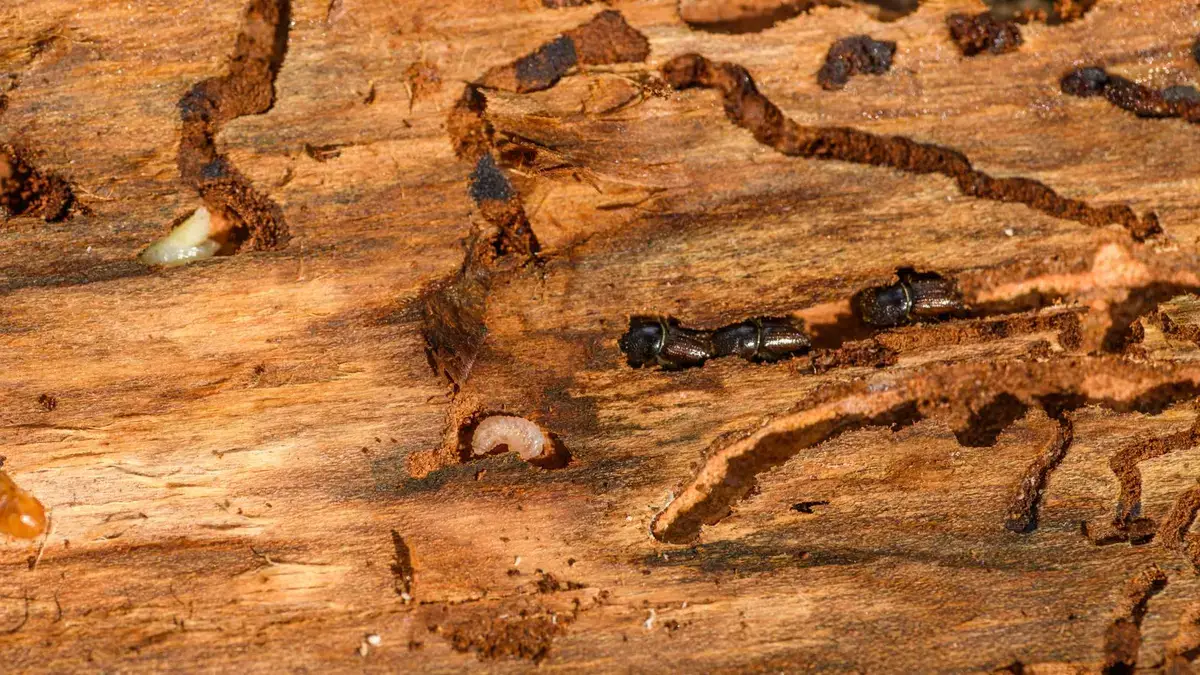
Most people in Bradley and Hamilton County do not discover termites by finding termites. They discover them by finding a small pile of wings on a windowsill in April, or by watching a cloud of winged insects pour out of a crack in the driveway on the first warm afternoon after a rain.
That moment is worth understanding, because it is the clearest signal a termite colony ever sends, and it lasts about forty minutes.
What a swarmer actually is
A mature termite colony produces winged reproductive members called alates, or swarmers. Their job is not to eat wood. Their job is to leave, pair off, and start new colonies somewhere else. They are the colony’s version of seeds.
That is why the timing matters so much. A colony does not produce swarmers in its first season. It produces them once it has grown large and stable enough to spare thousands of members, which for eastern subterranean termites generally means the colony has been working for several years.
A swarm is not the beginning of a termite problem. It is evidence of one that has been underway for a while.
When swarms happen around here
Eastern subterranean termites are the species most common across Tennessee, and their swarms follow weather more than the calendar. In East Tennessee the season generally runs through spring, and individual swarms tend to happen:
- On warm, still days, often in the middle of the day
- Frequently within a day or two of rain
- In short bursts, sometimes only twenty to sixty minutes
Because the window is so short, most homeowners never see the swarm itself. They see what it leaves behind.
The evidence people actually find
Swarmers shed their wings almost immediately after landing. Those wings are the single most common thing a homeowner brings to us:
Discarded wings. Usually collected along a windowsill, a door track, or a spider web near a light source. Termite swarmers are drawn to light, so they die at windows.
Mud tubes. Pencil-width tunnels of soil and saliva running up a foundation wall, a pier, or the inside of a crawl space. Subterranean termites build these to stay out of open air, which they cannot survive in for long.
Wood that sounds wrong. Trim, baseboards or subfloor that sounds hollow, or a spot that gives more than it should.
Bubbling or rippled paint. Sometimes mistaken for water damage, and sometimes it is water damage. Both are worth looking at.
Swarmers or flying ants?
Both swarm in spring, and the two get confused constantly. In general terms:
| Termite swarmer | Winged ant | |
|---|---|---|
| Waist | Straight, no pinch | Clearly pinched |
| Wings | Two pairs, roughly equal length | Front pair noticeably longer |
| Antennae | Straight, slightly beaded | Bent at an elbow |
This is useful for a first look, but it is not how the question gets settled. Wings on a sill tell you something landed there. They do not tell you where the colony is, how large it is, or whether the structure has been affected. That is what an inspection is for.
Why the wings matter more than they look
Swarmers are weak fliers. They do not cover long distances, and they are at the mercy of any breeze. When wings turn up inside a house, the reasonable reading is that they did not come from three streets over. They came from something on the property or immediately next to it.
That is the practical value of the evidence. It narrows the search from a neighborhood to a structure.
What to do with what you found
Keep it. A few wings in a plastic bag or a clear photo of the mud tube is more useful to an inspector than a description from memory.
Then leave the area alone. There is a strong instinct to spray what you can see, and with subterranean termites it works against you: the visible swarmers are the part of the colony that was leaving anyway. The colony is underground and unaffected.
An inspection is the step that turns evidence into a plan. It is where the structure gets checked, where conducive conditions like crawl space moisture get noted, and where treatment gets recommended based on what is actually there. Through Termite Shield, termite protection starts at $200, and treatment follows the inspection rather than preceding it.
One thing worth stating plainly, because it causes real confusion: routine pest control does not cover termites. They are different services, targeting a different insect, with different methods. If you have a pest plan for ants and roaches, it is not protecting you here. We wrote about why these are two separate services in more detail.
If you did not see anything
Termite activity is quiet by nature. Subterranean termites work inside wood and inside soil, and a colony can operate for years without producing a single visible sign at ground level. Homes that have never swarmed are not necessarily homes that have never been fed on.
That is the argument for inspecting on a schedule rather than on a scare, particularly for older homes and homes with crawl spaces, which is most of what we see around Cleveland, Charleston and Chattanooga.
If you found wings this spring, or you are simply due, tell us what you are seeing and we will get an inspection on the calendar.