
Every year around late September the calls change character. Through the summer they are about mosquitoes and ants. Then within about two weeks they become about roaches in the kitchen, mice in the pantry, and spiders in places nobody has looked since spring.
The usual explanation is that it got cold and everything came inside for warmth. That is close enough to be repeated everywhere and not quite right.
It is not the temperature, it is everything at once
Insects and rodents are not making a comfort decision. They are responding to several things changing simultaneously outside:
Food supply collapses. The insects that fed other insects die off. Seeds, fruit and garden growth are gone or harvested. What was an abundant landscape in July is a thin one in October.
Water gets less predictable. Standing water and irrigation stop.
Cover disappears. Leaf litter, tall growth and dense vegetation get cut back, raked and hauled away, which removes shelter at exactly the moment shelter matters more.
Breeding urgency rises. Species that overwinter as adults need somewhere protected to do it, and the search for that place intensifies.
Your house solves all four problems at once. It is warm, it has water, it has food, and nobody rakes the inside of a wall.
The move indoors is not a retreat from cold. It is a migration toward resources.
The openings were already there
This is the part worth internalizing, because it changes what you do about it. Autumn does not open holes in a house. Every gap being used in October was there in June, when the pests outside had no particular reason to care.
What changes is not the house. It is the value of the house.
Common routes, roughly in the order we find them:
- Under exterior doors. Worn or missing sweeps are the single most common entry point we see. If daylight is visible under a closed door, that is an opening.
- Where utilities enter. Gaps around water lines, gas lines, electrical conduit, cable and air conditioning line sets. These are usually sealed at installation and rarely resealed after any later work.
- Crawl space vents and access doors. Torn screens, doors that no longer seat.
- Dryer vents with damaged or missing flaps.
- Weep holes and gaps in siding, particularly where two materials meet.
- Garage doors, along the bottom seal and at the corners where the seal pulls away.
- Soffit and roofline gaps, which matter more than people expect once vegetation reaches the roof.
For scale: a mouse needs an opening roughly the diameter of a pencil. Rats need something closer to a quarter. Insects need far less than either. When homeowners look for entry points they tend to look for holes, and the real answer is usually a gap.
Anything touching the house is a bridge
If a branch, shrub, vine, woodpile, mulch bed or trellis is in contact with the exterior, it is a route that bypasses the ground entirely. Ants and roaches use vegetation constantly, and it puts them at siding level, at window level, and at roofline level rather than at the foundation where the house is best defended.
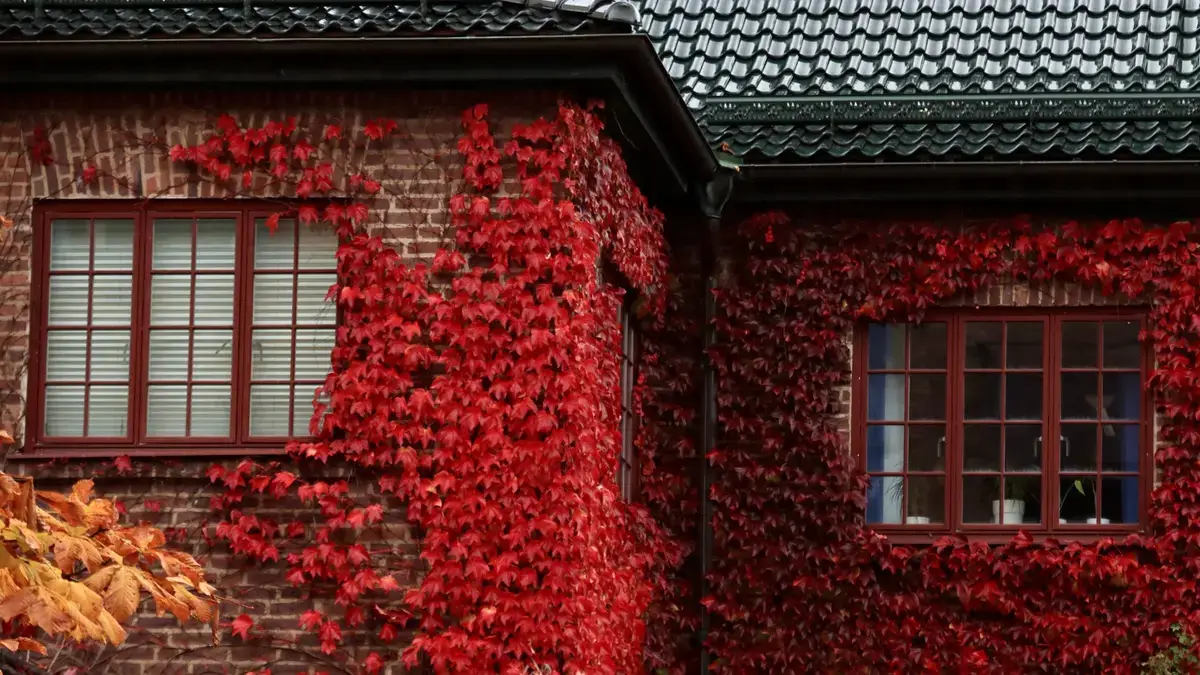
The ivy-covered wall is a good example. It is attractive and it is also continuous cover from soil to soffit.
A reasonable working rule is to keep plant material clear of the siding, keep mulch a few inches back from the foundation, and store firewood away from the house rather than against it.
The window that actually matters
The useful time to do something about this is before the pressure arrives, which in practice means late summer and early fall rather than the week after something turns up in the kitchen.
The reason is straightforward. Once a population has established itself inside a wall or under a floor, you are dealing with a problem indoors. Beforehand, you are dealing with a doorway. The doorway is cheaper and the work is more permanent.
A reasonable pass around your own house, taking half an hour:
- Walk the perimeter and look at every point where something enters the wall
- Close each exterior door and look for light at the bottom
- Check crawl space vents and the access door
- Look at where vegetation touches the building
- Check that downspouts discharge away from the foundation, since moisture draws pests independently of food
That covers most of what a homeowner can address directly. What it does not cover is the part that is already inside, or the routes that are not visible from the ground.
What we handle
Pest Shield, our residential pest work, starts at $65 as a starting point, and for ongoing pressure it works on a recurring basis because the pressure itself is recurring. A single treatment addresses what is present. It does not change the fact that outside conditions keep pushing new arrivals toward the same gaps.
Two things worth separating out, because they get lumped in with fall pest activity and should not be:
Termites are not seasonal in this sense. They do not come in from the cold. They live in the soil year round and are a separate service entirely, which we explain in why pest control and termite protection are different.
Crawl space moisture works on its own schedule and keeps drawing pests regardless of the month. That is covered in why East Tennessee crawl spaces stay damp.
If something has already started showing up inside, tell us what you are seeing and where. Where in the house it appears is often the most useful clue about how it got in.